
Gallery
Connor Holjes
United States
Credits
Cooper Union: School of Architecture
Cooper Union: Thesis Class of 2017
Thesis Advisor: Michael Young
Notes
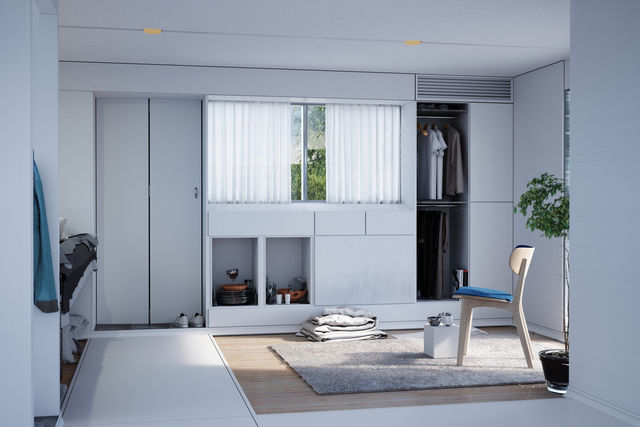
Attached is the final rendering for my Thesis at the Cooper Union. The final image was plotted at 86"x57" (9500x6332). Make sure to zoom in to see all of the details. My two main tools were 3dsmax and Fstorm. You can understand all of the small imperfections, contradictions and aesthetic and design decisions as intentional, no matter how small. Below is a brief statement about my Thesis to explain this way of working.
Rendering as a medium of representation is not unlike the core principles of painting or photography. Each medium is the recomposition of light, material, form, function and perspective. As a rendering approaches photoreal, we can begin to question the nature of the information embedded in the image for what it is. It is both a representation of something and often easily read as the thing itself. It is in this slippage that the core principles can be seen as adjustable parameters.
We can begin to understand the basic principles of this form of representation as parameters with a defined range. The software and all of its components that we use to represent reality become the defining factors by which we critique it. If we can understand the aesthetic implications of these variables, we can develop architectural criteria for reevaluating architecture.
I will go through two examples. In the final image, there is a hardwood floor and a molding. This relationship is something that is very common, especially in domestic architecture. The reading of the floor and the reveal begins to break down when we see the almost flat basebaord above the molding, the sub-molding below the traditional molding, the gap between the floor and the sub-molding, the shadow gap between the white floor and the sub-molding and the raised floor only present in the doorways. Our notion of the molding and the floor is defamiliarized by the subtle layering and displacement of architectural elements.
A simpler relationship is in the fabrics and pillows. On the bed sits a pillow. On the floor sits a thick bed cover, also known as a duvet. At first glance both appear to be soft-body objects, the blanket in a slightly more unusual location than the pillow. However, the pillow is low-poly, and the duvet is high-poly. Now, we begin to question the aesthetic of the soft-body objects in the scene. Is the pillow poorly modeled or is the pillow designed to look like a low-poly 3d object. And if it is intended to look like a low-poly 3d object then it technically is a high-poly model of a low-poly object, and once again we lose the original interpretation of the relationship.
As we study the image, we begin to find intentional imperfections and inherent contradictions in many locations. Thank you for this opportunity to share my work. Feel free to email me if you have any questions [ cdholjes@gmail.com ].