
Gallery
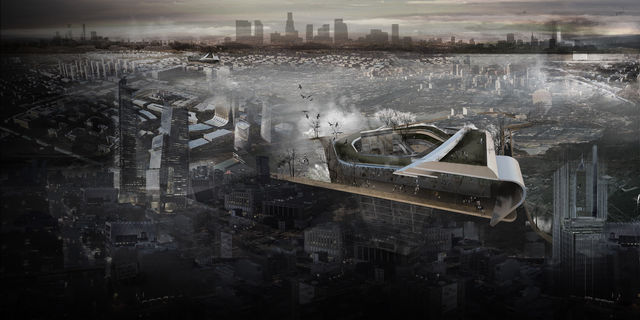
Kenny Punsu
Indonesia
Credits
Kenny Punsu
Architecture student of Tarumanagara University, Indonesia - Class of 2012
Notes
7th term architectural project.
The Rise of the Groundscraper : A Reborn of a Ground Control
In this competitive world, the gap between actors in the city has somehow been positioned the minority at the poorest part of the city, ignoring them living at the residual space, causing jealousy and uncontrollable growth of informal settlement from the centre of the city to the periphery. The rapid growth of sterile vertical development for the mid and high classes are contrast to the organic development of the informal, filling the ground foot print organically with less productive and less connected fabric to the surrounding environment. Moreover, the gentrification trend has resulted increased property values and displacing of lower income inhabitants and local businesses.
The battle between the poor and middle-income competitors requires mediation: an architecture intervention that can act as a tool to compromise the complex problem between those actors. As land becomes limited in the city centre, while the development becomes unavoidable, open spaces are taken for the sake of commercial purpose; bringing city as cramped and crowded with more compact and dense fabric. The void in the city is fundamental to bond relationship between people, where ground shall perform as the platform to be served as the public space if less accommodated, communication and network are cut, leaving the inhabitant become more individualistic and less participation in the city.
Karet Belakang - Setiabudi
The so-called, Karet Belakang area, located at Setiabudi district is considered as a site, which is debated as being gentrified. New innovation is required to compromise the new development of the area while retaining the local resources. The idea of groundscraper is tested as the mirrored image of skyscraper, an infill project whose system is injected to the site to maneuver its surrounding environment. At the ground’s surface, the groundscaper presents a synthetic landscape, a truly public space, where people can gather and mingle without realizing being filtered before entering to the building located at the below part of this open space. The blurring image of groundscraper as a park in the city contributes more void to the city and communal space to the inhabitants, a prototype of a controller to accommodate both parties: formal and informal sector, by facilitating new cycle of supply, distribution, production and sales; engaging various sectors to collaborate.
By having a mirror image of a skyscraper, the groundscaper minimize building footprint, with new green technology elevates the solar system inside the building to improve energy efficiency, natural light distributed by using reflective mirrors and solar chimney, contributing economical value for the building and environment in a longer term. Water efficiency is optimalized by creating closed loop from the ground surface as the water catchments to irrigate water between floors by continuing landscape in a staggered ways to the lowest level. More programs has been added to enhance the building performance and to neutralize gentrification such as commercial, transportation hub, property, office, industry, farming and recycle facility where dedicated for wider public.